Cleaning Around Parrots Without Guessing
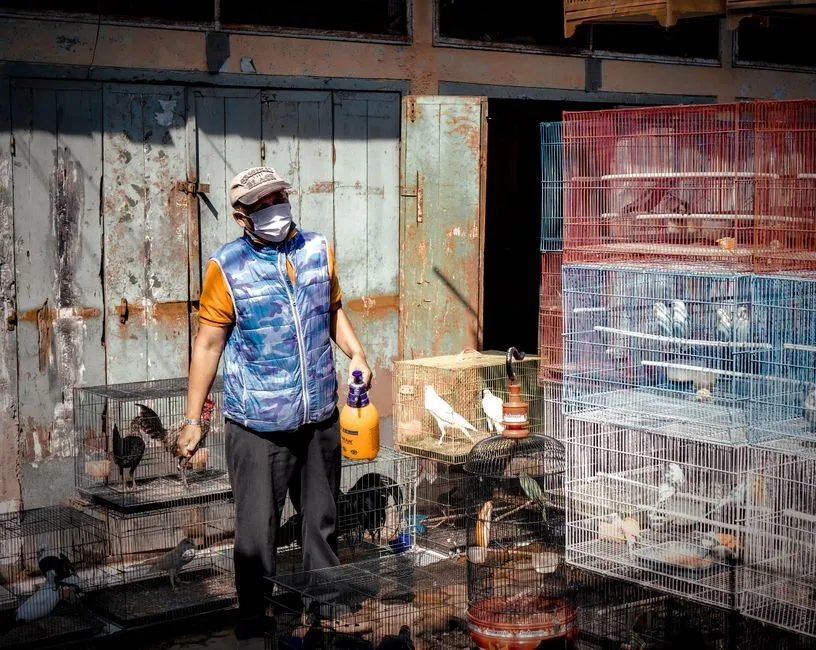
- How can you clean safely around a parrot?
- What should you decide before opening a product?
- Where should the parrot go during cleaning?
- Does “natural,” unscented, or bird-branded mean safe?
- What is the safest order for routine cleaning?
- Should you disinfect every time?
- How should bowls, perches, and toys be handled?
- What about floors, walls, and the wider room?
- Can you use a pesticide in a parrot room?
- When can the parrot return?
- What should you do after a possible cleaner exposure?
- Sources
How can you clean safely around a parrot?
Move the bird to a separate, clean-air location before opening or applying a cleaner. Read the full product label, remove bowls and toys from the work area, prevent spray and splash, ventilate exactly as directed, rinse every bird-contact surface until no residue remains, and keep the bird away for the label's complete re-entry period. No cleaner is universally “parrot-safe.” Fumes or illness after exposure require fresh air and immediate advice from an avian veterinarian.
Cleaning has two separate jobs: physically removing droppings, food, dust, and debris, then using a labelled product only when the surface and hygiene purpose require it. More chemical is not a substitute for better removal.
What should you decide before opening a product?
Define the surface, soil, and result. A washable metal tray with dried droppings, a sealed floor with spilled food, a porous rope toy, and a room treated for pests are not the same task. One product and one return time cannot safely cover all four.
Check these points first:
- Is this routine cleaning or a disease-control instruction from an avian veterinarian?
- Does the product label name the surface and intended use?
- Can the bird remain in a genuinely separate air space during use and ventilation?
- Can bowls, food, water, toys, liners, and removable perches leave the work zone?
- Can the surface be rinsed and fully inspected before contact?
- Does the label require gloves, eye protection, ventilation, dilution, or a re-entry interval?
- Who will respond if the bird is exposed?
If an avian veterinarian has supplied an infection-control plan, follow that plan and the product label together. Do not substitute a household recipe or change a concentration.
Where should the parrot go during cleaning?
Use a secure cage or carrier in a separate location with clean air, a closed door, safe temperature, and no cooking, smoke, aerosols, repairs, or other animals. Moving the bird to the other side of the same room does not control fumes, droplets, or disturbed dust.
Plan the route before starting. Close exterior doors and windows along the transfer path, stop fans, and keep other pets separated. Move the bird first, then remove food, water, dishes, toys, liners, and any washable accessories from the treatment area.
The Association of Avian Veterinarians warns that the avian respiratory tract is extremely sensitive to inhaled chemicals and names air fresheners, aerosols, paints, fumigants, drain cleaners, insecticides, ammonia, and bleach among airborne concerns. MSD likewise says birds are sensitive to fumes from cleaners, pesticides, perfumes, and sprays.
Does “natural,” unscented, or bird-branded mean safe?
No label word proves universal safety for every bird, product, surface, concentration, and use pattern. “Natural” does not state what a bird may inhale, ingest from a surface, or collect on its feet and feathers. Unscented does not mean vapor-free. A bird image or cage claim does not replace directions, warnings, rinsing, and re-entry conditions.
Use the original container and current label. The U.S. Environmental Protection Agency advises reading labels before buying, storing, and using cleaners or pesticides, following precautions, keeping pets away as directed, and retaining the labelled container for emergency information.
Do not transfer a cleaner into a food or drink bottle. Do not rely on a social-media dilution or a handwritten name on an unlabelled spray bottle. If the directions are missing, the product is not ready for use around the bird's environment.
What is the safest order for routine cleaning?
Use a clean-to-dirty workflow that minimizes airborne debris:
- Secure the bird elsewhere. Confirm clean air and a closed transfer route.
- Remove contact items. Take out food, water, bowls, toys, liners, and removable perches.
- Remove dry debris gently. Lift liners and loose material without shaking them. Do not blow dust with compressed air.
- Loosen stuck soil. Use the surface manufacturer's cleaning method and avoid aggressive scraping that damages coatings.
- Wash. Apply only a product and method permitted for that material, with the labelled protection and ventilation.
- Rinse. Remove soap or disinfectant residue from the cage, accessories, bowls, and feeding equipment.
- Dry and inspect. Check joints, welds, coating, fasteners, cracks, porous parts, loose fibres, and trapped liquid.
- Reset with clean hands. Return clean bowls, water, food, toys, and liners without carrying residue back from the work zone.
- Return the bird last. Meet every label condition and confirm that air, surfaces, equipment, and room temperature are appropriate.
VCA's current cage-hygiene guidance specifically requires the bird to be out of the room when fume-producing disinfectants are used and stresses complete rinsing so residue does not remain on cages, accessories, or feeding utensils.
Should you disinfect every time?
Not automatically. Routine removal and washing may be the correct task for ordinary soil, while a confirmed disease, quarantine, shared equipment, or veterinary instruction may require a specific disinfectant process. The organism, surface, product, concentration, contact time, rinse requirement, and re-entry condition all matter.
Ask an avian veterinarian for a disease-specific plan. Do not infer that a product effective on one organism, at one concentration, on one hard surface is appropriate for a porous perch, food bowl, toy, wall, or room with a bird.
Never mix cleaning products. In particular, MSD warns that mixing household bleach and ammonia produces a highly toxic gas. Keep products in their original containers, use one labelled system at a time, and follow disposal instructions.
How should bowls, perches, and toys be handled?
Food and water dishes need a dedicated clean zone away from chemical spray, dirty cage parts, and pet-food storage. Wash and rinse them thoroughly, inspect chips and cracks, and dry them before refilling. EPA says not to spray or store cleaners and pesticides near pet food or water dishes.
Smooth, intact items can often be washed more reliably than porous, frayed, cracked, or heavily soiled ones. VCA notes that dirt can penetrate porous wood, wicker, and bamboo and advises regular inspection and replacement. Rope and fabric also need checks for loose strings and retained soil.
Follow each item's manufacturer instructions. Discard a part that cannot be cleaned, rinsed, dried, or restored to safe condition. Do not coat, seal, heat, or chemically soak a bird-contact item unless the exact product instructions and avian veterinarian support that use.
What about floors, walls, and the wider room?
Work outward from the cage without creating a path through wet cleaner. Keep the bird's carrier, clean bowls, and fresh supplies outside the work zone. Use stable equipment from floor level; overhead fixtures, mains electrical work, damaged outlets, and structural repairs require a qualified trade.
Do not spray into the air to “freshen” the room. Remove the source of an odor, clean the affected surface, and ventilate according to the label and safe household conditions. Air fresheners, scented candles, essential-oil diffusers, foggers, and aerosol deodorizing are not cleaning steps for a parrot room.
PTFE/Teflon fumes can kill birds. Cleaning does not make an overheated non-stick coating safe, and a pleasant smell does not rule out a dangerous gas. Keep birds away from cooking, self-cleaning ovens, heated coated appliances, smoke, and repair fumes. The PTFE danger guide covers the emergency boundary.
Can you use a pesticide in a parrot room?
Only within the exact label and with professional or avian-veterinary input appropriate to the problem. EPA states that using a pesticide inconsistently with its label is illegal. It recommends nonchemical controls where possible, removing pets from the application area, and keeping them away for the labelled period.
Do not improvise a spray, bait placement, concentration, fogging method, or re-entry time. Ask the applicator for the product name, registration information, full label, treated area, ventilation instructions, residue controls, and written bird re-entry conditions before work begins. If those conditions cannot be met, the bird needs a different location and the plan needs review by an avian veterinarian.
When can the parrot return?
Return the bird only when all applicable conditions are true:
- the product's complete labelled re-entry period has passed;
- required ventilation is complete;
- every bird-contact item and surface has been rinsed as directed;
- there is no trapped liquid, loose residue, damaged coating, frayed material, or open container;
- clean food and water are in clean dishes;
- the room has no active spray, cooking, smoke, repair, pest-control, or heated-coating source; and
- the bird can move from carrier to cage without an open door, fan, pet, or other flight hazard.
Do not shorten the interval because a smell has disappeared. Harmful exposures are not reliably measured by the human nose. If the label is ambiguous about birds, call the manufacturer and an avian veterinarian before use, not after application.
What should you do after a possible cleaner exposure?
Move the bird to fresh air without exposing yourself to the source, stop further contact, and call an avian veterinarian or emergency service immediately. Do not wait for symptoms. Breathing difficulty, weakness, loss of coordination, eye or skin exposure, vomiting, collapse, or any sudden behavior change needs urgent veterinary direction.
Bring the original container or clear photographs of the full label, plus the time, route, amount if known, surface, ventilation, and actions already taken. Do not induce vomiting, bathe the bird, give food, fluids, medicine, or use a home remedy unless the avian veterinarian specifically instructs it.