The 8 Best Parrots for Beginners (and 3 to Avoid at First)
- Which parrots are best for beginners?
- What makes a parrot a reasonable first match?
- Seven beginner shortlists, with the tradeoffs intact
- Compare the seven shortlists
- Which parrots should most beginners avoid?
- Run this pre-adoption test
- Set up health and diet safely
- Eliminate the PTFE/Teflon fume hazard
- Know the illness line before day one
- The bottom line
Which parrots are best for beginners?
Budgerigars and cockatiels are the strongest first shortlists for many homes, while lineolated parakeets, Bourke's parakeets, Pacific parrotlets, green-cheeked conures, and rosy-faced lovebirds can fit narrower preferences. None is an "easy pet." Choose by adult noise, social needs, housing, veterinary access, household safety, and a commitment that may last from roughly a decade to several decades.
This guide is a fit screen, not a ranking of personalities. Species patterns help you ask better questions, but they do not guarantee that a particular bird will be quiet, cuddly, talkative, or tolerant of handling. Meet the individual bird, learn its history, and arrange an examination with an avian veterinarian.
What makes a parrot a reasonable first match?
A good first parrot is not simply small or inexpensive. It is a bird whose normal needs your household can meet every day.
For a broader taxonomy before making a shortlist, use our complete guide to parrot species.
The Merck Veterinary Manual's bird-selection guide tells prospective owners to consider time, veterinary care, cage size, cost, and noise. Use those categories before looking at colour or talking videos.
Noise your household can actually accept
Every parrot vocalises. "Quiet" is always relative to other parrots, not silent. Ask a rescue, breeder, or experienced foster carer to let you hear the species at its ordinary loudest. Consider sleep schedules, shared walls, remote meetings, babies, and noise-sensitive people.
Do not rely on body size alone. The World Parrot Trust describes a budgerigar's call as quiet warbling through sharp chatter and a quiet screech. It describes the Pacific parrotlet's calls as high-pitched and rapid, with constant chatter in a flock. A small bird can still produce a sound that does not suit a particular home.
Space for movement, not just a cage footprint
The cage has to match the bird's body, tail, activity, and safe bar spacing, with room for perches and enrichment that does not block movement. Out-of-cage time also needs a bird-safe room. Our parrot cage-size guide explains how to measure the bird and assess a specific enclosure.
A small bird generally needs less massive equipment than a macaw, but "small" does not mean a tabletop cage is adequate. The bird must be able to move normally without feathers striking bars or furnishings.
Social and training capacity
Parrots are social, intelligent animals. Daily interaction, foraging opportunities, sleep, cleaning, and training must fit the household for the bird's life, not only during the exciting first month. Merck specifically notes that larger parrots such as cockatoos and African greys require substantial daily interaction.
Avoid fixed online prescriptions such as "two hours is enough" or "near-constant attention is required." The useful question is whether your bird is showing normal behaviour and whether the daily plan supplies social contact, choice, exercise, foraging, and rest. An avian veterinarian or qualified parrot-behaviour professional can help assess a mismatch.
A realistic lifetime commitment
Published lifespan estimates differ because sources use different records and populations. Treat every number as planning context, not a warranty. The conservative approach is to make care, housing, and succession plans beyond the middle of the cited range.
Access to an avian veterinarian
Locate a licensed avian or exotics veterinarian before bringing a bird home. Ask whether the practice accepts new patients, who handles after-hours emergencies, and how quickly a new-bird examination can be scheduled. Purchase price is only the beginning; cage, carrier, food, enrichment, routine care, and emergency care continue throughout the bird's life. See our parrot cost guide for the categories to budget.
Seven beginner shortlists, with the tradeoffs intact
1. Budgerigar (budgie or parakeet)
A budgie is often the most workable first shortlist for an apartment or a household that wants a small, active parrot. Merck describes budgies as not usually loud and able to learn to talk. The World Parrot Trust budgerigar profile lists a 15-year longevity figure, while Merck gives an average range of 5-10 years. That disagreement is a reason to plan long, not to pick the number you prefer.
The tradeoff is scale. A small bird can deteriorate quickly and subtle changes are easy to miss. A budgie still needs an appropriately sized enclosure, foraging, flight or movement opportunities, daily observation, and veterinary care. It is not a low-care decoration.
Best fit: a home that wants a small parrot, can protect it from doors, fans, windows, other pets, and fumes, and will observe it closely.
2. Cockatiel
Cockatiels are a strong first shortlist for people who want a somewhat larger small parrot with expressive visual signals and a generally manageable voice. Merck calls them vocal but relatively quiet compared with macaws or cockatoos. Both Merck and the World Parrot Trust cockatiel profile use about 20 years as a planning figure, rather than the older article's unsupported 15-25-year range.
Cockatiels create feather dust. Anyone with asthma, allergies, or another respiratory concern should discuss the home setup with their clinician and the bird's care with an avian veterinarian before committing. Air filtration and cleaning do not make every respiratory situation safe.
Best fit: a household comfortable with daily vocalising, dust, a long commitment, and regular interaction.
3. Lineolated parakeet (barred parakeet or linnie)
The lineolated parakeet is worth considering when the sound profile matters. The World Parrot Trust barred-parakeet profile describes soft but far-carrying calls and gives a longevity figure of 15 or more years. It also notes climbing and foraging enrichment, useful reminders that "quieter" does not mean inactive.
Availability and competent veterinary familiarity may be more limited than for budgies or cockatiels. Confirm that you can obtain an appropriately weaned, legally sourced bird and qualified care before choosing one.
Best fit: a quieter household prepared to provide climbing, bathing, foraging, and species-appropriate housing.
4. Bourke's parakeet
Bourke's parakeets can suit someone who values gentler vocalisations and observation more than speech or intense physical interaction. World Parrot Trust describes their calls as mellow or plaintive and softer than similar budgerigar calls. Its Bourke's parrot profile gives 12 years; Merck places grass parakeets, including Bourke's, at 8-13 years.
Do not buy one expecting a miniature cuddly parrot. Individual handling history matters, and a nervous bird needs patient, choice-based trust building.
Best fit: a calm home that accepts a more watchful relationship and can protect a small bird during exercise.
5. Pacific parrotlet
"Parrotlet" and "Pacific parrotlet" were counted as two entries in the previous guide. They are one entry here: the Pacific parrotlet, Forpus coelestis. The World Parrot Trust profile lists a 12.5 cm body length, high-pitched rapid calls, and longevity up to 25 years. Those specifics correct the earlier picture of an automatically quiet 15-20-year pet.
A very small body does not make territorial or defensive behaviour harmless, and daily forced handling is not the solution. Use positive reinforcement, respect avoidance signals, and provide an enclosure and routine designed for active climbing and foraging.
Best fit: an attentive owner who wants a very small, active parrot and will train without coercion.
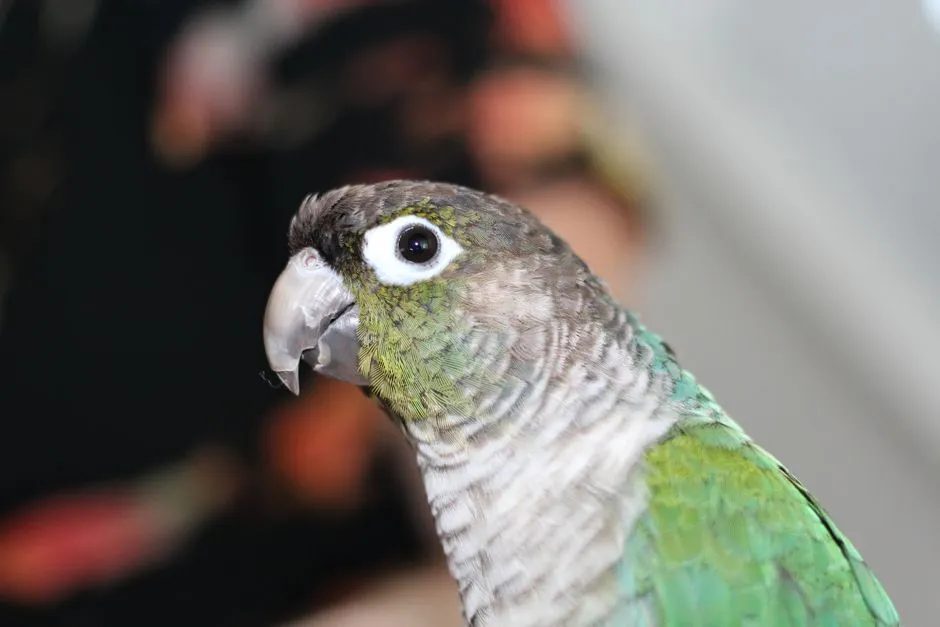
6. Green-cheeked conure
A green-cheeked conure may fit a first-time owner who has more tolerance for activity, mess, contact calls, and a larger commitment. Merck groups green-cheeked conures with small Pyrrhura conures, describes them as relatively quiet, and gives longevity up to 25 years. The World Parrot Trust profile lists 26 cm, 60-80 g, and 10 or more years. Neither source supports treating "20-30 years" as a precise universal lifespan.
"Quieter than a sun conure" is not the same as quiet enough for your home. Spend time around adult green-cheeked conures before deciding, and plan for active enrichment rather than buying for the online image of a permanently cuddly bird.
Best fit: a household prepared for a more active small-to-medium parrot and variable vocalising.
7. Rosy-faced lovebird (peach-faced lovebird)
The common name "peach-faced lovebird" usually refers to the rosy-faced lovebird, Agapornis roseicollis. The World Parrot Trust profile describes shrill, metallic calls and gives 15 years. Merck gives lovebirds up to 20 years and notes that breeding season can affect mood. That is more useful than calling them minimally noisy.
A single-versus-pair decision should not be made from the promise that a single bird will bond more strongly to a person. Social history, species, sex, housing, and the individual all matter. Discuss companionship and introductions with an avian veterinarian or experienced rescue, and do not use human attention as a guaranteed replacement for compatible bird social contact.
Best fit: an active household that accepts sharp calls and will manage social needs without forcing handling.
Compare the seven shortlists
| Species | Source-backed sound clue | Published longevity context | Main first-owner tradeoff |
|---|---|---|---|
| Budgerigar | Warbling, chatter, quiet screech | Merck 5-10 years; WPT 15 years | Subtle illness and small-body hazards |
| Cockatiel | Vocal, quieter than large parrots | Up to/about 20 years | Feather dust and long commitment |
| Lineolated parakeet | Soft but far-carrying calls | 15+ years | Availability and climbing needs |
| Bourke's parakeet | Mellow, softer calls | WPT 12 years; Merck 8-13 years for grass parakeets | Often more observational than cuddly |
| Pacific parrotlet | High-pitched, rapid chatter | Up to 25 years | Territorial behaviour despite tiny size |
| Green-cheeked conure | Relatively quiet for a conure | WPT 10+ years; Merck up to 25 years for small conures | Activity, mess, and variable volume |
| Rosy-faced lovebird | Shrill, metallic calls | WPT 15 years; Merck up to 20 years | Sharp calls and social management |
These are source descriptions and planning figures, not predictions for an individual bird.
Which parrots should most beginners avoid?
Cockatoos
Merck explicitly says cockatoos are not for inexperienced owners. It describes them as very loud when screaming, demanding of handling and attention, and likely to chew. Its table gives 25-50 years, replacing the former unsourced 40-70-year range.
Large macaws
Merck describes macaws as the largest parrots, with very loud screaming voices, substantial exercise and attention needs, and 30-60-year average lifespans. The beak, enclosure, transport, household-proofing, and long-term care all operate at a scale a new owner should experience before accepting.
African grey parrots
Merck gives African greys 30-50 years and describes them as requiring a great deal of time and attention, with intelligence that can accompany behaviour problems. They are not disqualified by intelligence; the issue is the depth and duration of the care commitment.
None of these species is a bad animal. They are poor default recommendations for someone who has not yet managed parrot noise, household safety, veterinary logistics, training, and long-term care.
Run this pre-adoption test
Before paying a deposit or agreeing to an adoption, answer these with evidence:
- Adult sound: Have I heard this species vocalise in person, not only in an edited video?
- Daily routine: Who provides food, cleaning, movement, training, foraging, and social contact every day?
- Absence plan: What happens during work travel, illness, holidays, or a housing change?
- Veterinary route: Which avian or exotics veterinarian will examine the bird, and who covers emergencies?
- Housing: Is the cage correctly sized and spaced for this individual, with a safe exercise room?
- Air: Can the home eliminate heated PTFE/Teflon and other non-stick-coated items around the bird, and keep the bird away from smoke, aerosols, and cooking fumes?
- Other animals: Can physical separation from cats, dogs, and larger birds be maintained?
- Money: Does the budget include routine and emergency veterinary care, not merely purchase price?
- Lifetime: Who can assume care if the bird outlives the owner's circumstances?
- Source: Is the bird legally and responsibly sourced, with health and history records?
Merck recommends learning the species, using reputable sources, checking the bird's living conditions, and arranging an examination by a veterinarian who knows birds. Adoption from a knowledgeable rescue can also provide valuable behavioural history.
Set up health and diet safely
Have the cage, carrier, perches, water, food, and first veterinary appointment ready before arrival. Our new-parrot supplies checklist covers the equipment categories.
Diet should be species-specific. The Association of Avian Veterinarians' Basic Care for Companion Birds warns that seed-only diets can cause malnutrition, but it also gives a small-parrot caveat: budgerigars, parrotlets, lovebirds, and cockatiels may be offered pellets plus measured seeds rather than a pellet-only diet. Do not make a sudden conversion or choose proportions from a generic article; ask the bird's avian veterinarian.
Keep chocolate, alcohol, caffeine, avocado, highly salted foods, onion, garlic, fruit pits or apple seeds, and xylitol away from birds. The AAV's household-danger guidance explains the food risks and distinguishes an accidental occasional apple seed from intentionally feeding fruit seeds. If exposure is suspected, contact an avian veterinarian or animal poison service immediately. Do not wait for symptoms.
Eliminate the PTFE/Teflon fume hazard
Fumes released when PTFE/Teflon or another non-stick coating is overheated can be rapidly fatal to a bird. This is not limited to frying pans. The Association of Avian Veterinarians warns that the coating may also be present on self-cleaning ovens, drip pans, space heaters, irons, and heat lamps. Identify coated items before bringing a bird home, keep the bird out of cooking areas, and do not use a suspect coated appliance around it.
If PTFE/Teflon or non-stick fume exposure may have occurred, move the bird to uncontaminated air without delaying professional help and call an avian veterinarian or emergency veterinary service immediately. A bird that appears normal still needs expert direction because waiting for visible breathing trouble can waste critical time.
Know the illness line before day one
Birds can conceal illness. The Merck Veterinary Manual illness guide lists fluffed feathers, sleeping more, reduced activity or vocalising, sitting low or on the cage floor, weakness, balance loss, breathing difficulty or tail bobbing, droppings changes, appetite or thirst changes, and vomiting as reasons to seek veterinary care.
Breathing difficulty, collapse, active bleeding, trauma, suspected poisoning, or a bird on the cage floor needs urgent professional triage. Keep the clinic and emergency numbers available and a transport carrier ready. Do not use online advice to delay care.
The bottom line
For many first-time owners, start the conversation with a budgie or cockatiel. Add a lineolated parakeet or Bourke's parakeet when a softer sound profile matters; consider a Pacific parrotlet, green-cheeked conure, or rosy-faced lovebird only after accepting their specific social, sound, and activity tradeoffs.
The best beginner parrot is the individual whose adult needs fit your real household and whose care you can fund for its full life. Species is the shortlist. A veterinary plan, safe home, honest sound test, and long-term commitment make the decision.
This article is general educational information about pet-bird care, not veterinary advice. For any health, diet, or safety question about your bird, consult a licensed avian or exotics veterinarian who can examine it. Never use this guide to delay professional care.